
REVIEW: Why They Can’t Write by John Warner
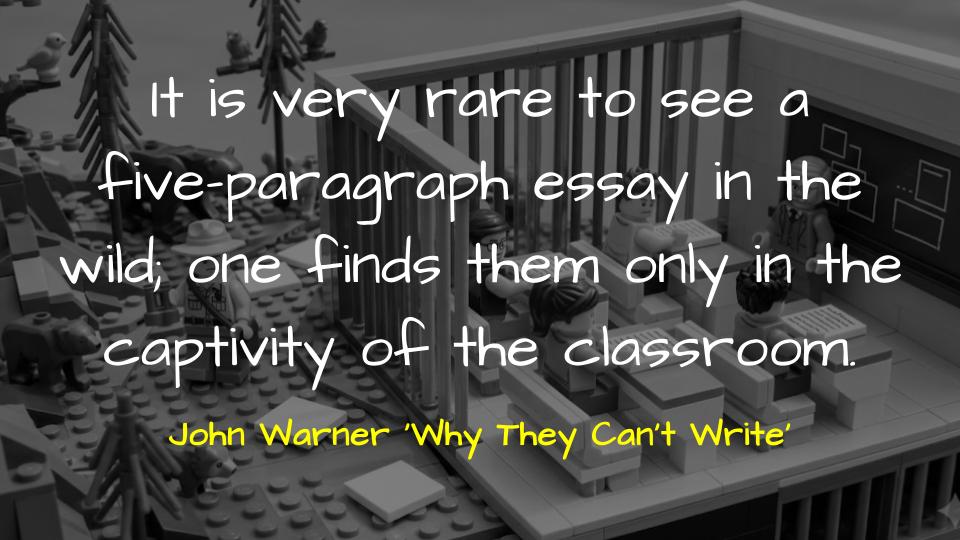
John Warner’s Why They Can’t Write: Killing the Five-Paragraph Essay and Other Necessities is a critique of how we fail to properly teach writing in the modern era, with a particular focus on the college system in the US. While it’s easy to point the finger at the “five-paragraph essay” as the primary villain, Warner argues that this rigid structure can be seen as a canary in the coal mine. The true issue lies in a systemic obsession with testing, surveillance, and “efficiency” that has effectively hollowed out the act of writing, leaving behind only an imitation.
One of the ways Warner makes sense of the problem is by making the comparison between modern writing instruction to an acting school where students only learn impressions of other actors, rather than how to build a performance from the ground up.
Imagine an acting school where rather than helping students develop the individual skills of building a performance, students are instead required to learn a series of impressions of genuine actors performing a role.
Source: Why They Can’t Write by John Warner
In classrooms, students are not asked to write, instead they are asked to create artefacts that look like writing but lack the spark of human choice.
To write is to make choices, word by word, sentence by sentence, paragraph by paragraph. Writers choose what they want to write about, whom they want to write to, and why they’re writing.
Source: Why They Can’t Write by John Warner
When these choices are replaced with a template, students are not taught a skill, rather they are being trained for compliance. The five-paragraph essay is the “ab belt” of the classroom – a shortcut that promises results without the “sit-ups” of actual thought.
If writing is like exercise, the five-paragraph essay is like one of those ab belt doohickeys that claim to electroshock your core into a six-pack, so you can avoid doing all those annoying sit-ups.
Source: Why They Can’t Write by John Warner
In response to this, Warner proposes moving away from “competency-based” assessments toward a model of practice. He defines a writer’s practice through four dimensions:
- Knowledge: Understanding what writers know about the world and their craft.
- Skills: The technical ability to conceive, draft, revise, and edit.
- Habits of Mind: How a writer thinks—curiosity, empathy, and audience awareness.
- Attitudes: Believing that writing is a difficult, iterative process of discovery.
In this situation, the goal is not a perfect final product, but the “noble failure” of trying to say something meaningful and falling just short, only to get back into the arena and try again.
As long as students are writing, and writing with purpose, their writing will improve.
Source: Why They Can’t Write by John Warner
The focus here for the educator is to support students with the metacognitive reflections required to see the links between different writing-related tasks. Associated with this, there is a call to end the tyranny of grades.
These should be our goals: We seek to increase educational challenges while simultaneously decreasing student stress and anxiety related to writing. We seek to change the orientation of school from only preparing students (poorly, as it turns out) for the indefinite future to also living and learning in the present. We seek to provide experiences designed around learning and growth, rather than giving assignments and testing for competencies. We will end the tyranny of grades and replace them with self-assessment and reflection. We will give teachers sufficient time, freedom, and resources to teach effectively. In return, they will be required to embrace the same ethos of self-assessment and reflection expected of students.
Source: Why They Can’t Write by John Warner
I remember starting this book a few years ago, but never got around to finishing it. It was interesting to return to this with the changes brought about by the explosion of Large Language Models. Written before their explosion, Warner’s highlights are somewhat prophetic. If writing in school has become a “simulacrum” or “pseudo-academic BS” designed to trigger an algorithm, then AI is the ultimate fulfilment of that broken system. The answer is not better AI detectors, rather it is about doubling down on what AI cannot replicate, that is the agency of solving problems for a particular purpose.
We should not ask students to write anything that will not be read.
Source: Why They Can’t Write by John Warner
Writing instruction must shift toward the “potholes”. The problem is that if it is “frictionless” (as AI makes it), no learning occurs. We need the “heat” that comes from the friction of a student struggling to find their own words.
Technological solutions to the problems of learning value a “frictionless” experience, but we shouldn’t forget that friction makes heat and heat is energy. As Bernard Fryshman, a professor of physics with fifty years of experience, says, one of faculties’ most important roles is to “jostle students into active learning.”
Source: Why They Can’t Write by John Warner
This has me thinking again about Seymour Papert’s idea of hard fun.
It is expressed in many different ways, all of which all boil down to the conclusion that everyone likes hard challenging things to do. But they have to be the right things matched to the individual and to the culture of the times. These rapidly changing times challenge educators to find areas of work that are hard in the right way: they must connect with the kids and also with the areas of knowledge, skills and (don’t let us forget) ethic adults will need for the future world.
Source: Hard Fun by Seymour Papert
The question I am left with is what this means in the early years and the move towards direct instruction?
REVIEW: Why They Can’t Write by John Warner by Aaron Davis is licensed under a Creative Commons Attribution-ShareAlike 4.0 International License.


